EV Charging Connectors and Cables: Which Plug Fits Your Car?
Match your EV inlet to the right AC cable or DC charger. Compare Type 1, Type 2, CCS, NACS, CHAdeMO and GB/T, and check imported cars.
Table of Contents
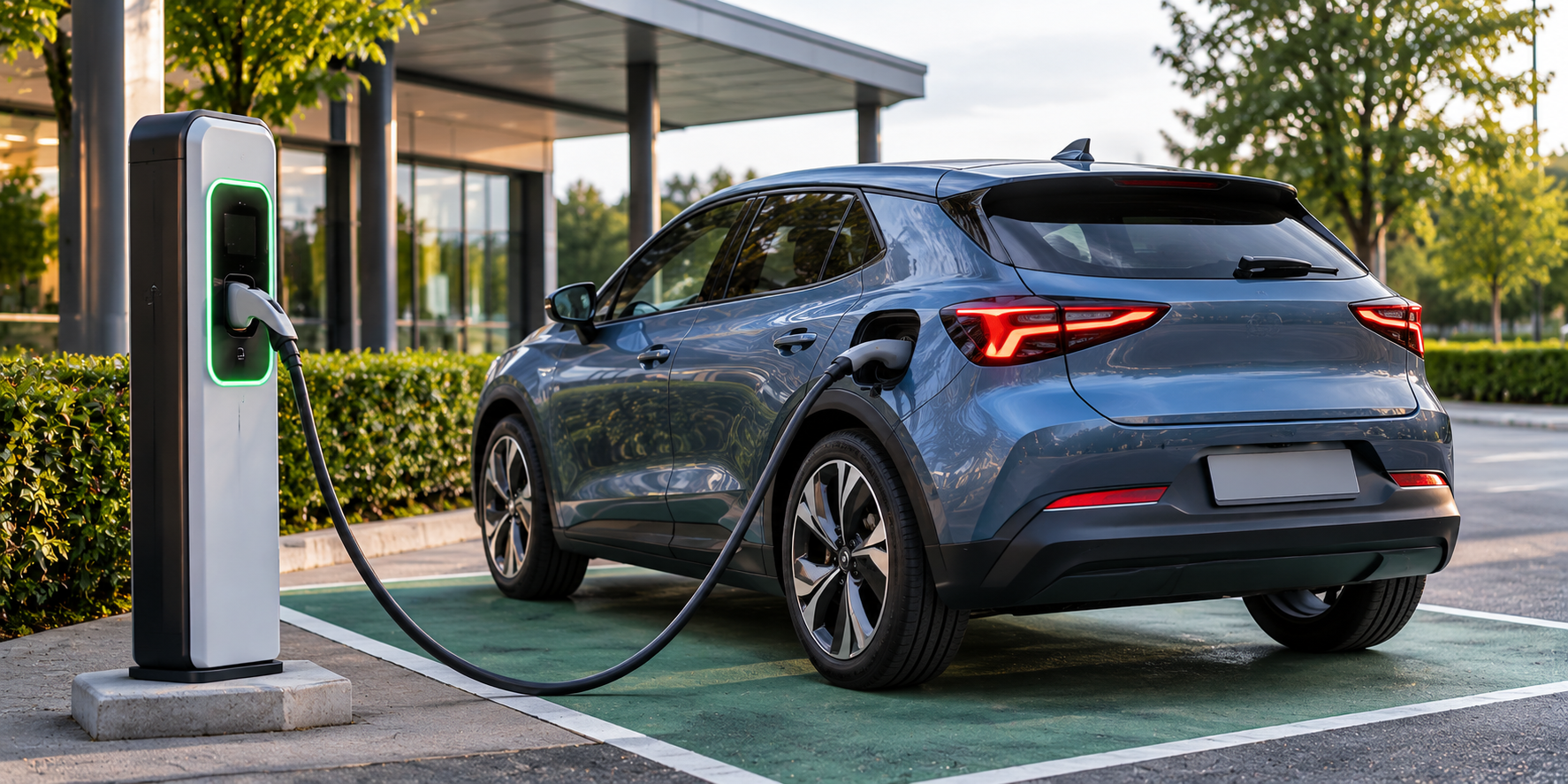
Buying an EV charging cable starts with two checks: what inlet is on the car, and what is on the other end at the charge point? A socketed public AC post may require a cable from your boot. A DC fast charger supplies its own. For an imported EV, confirm both AC and DC compatibility before paying a deposit.
EV plug compatibility by market
The table shows typical passenger-car installations and important exceptions. Check the exact connector at the bay. A combined CCS inlet accepts its regional AC plug in the upper section. A CCS DC plug also engages the two large lower contacts.
| Market or vehicle origin | Car inlet | Supply | Typical charge-point cable | What to use |
|---|---|---|---|---|
| UK, EU and Australia | Type 2 or upper section of CCS2 | AC | Socketed or tethered | Bring Type 2–to–Type 2 for a Type 2 socket. Use the attached Type 2 lead where fitted. |
| UK, EU and Australia | CCS Combo 2 (CCS2) | DC | Tethered | Use the station’s CCS2 plug. |
| US and Canada | Type 1 (SAE J1772) or upper section of CCS1 | AC | Usually tethered | Use the station’s J1772 lead. |
| US and Canada | CCS Combo 1 (CCS1) | DC | Tethered | Use the station’s CCS1 lead. |
| US and Canada | SAE J3400 (NACS) | AC or DC | Commonly tethered | Use the J3400 lead for the supported charging mode. Verify network and vehicle eligibility for DC. |
| Japan and some older cars sold abroad | Type 1 on relevant models | AC | Often tethered in Japan. Socketed Type 2 posts elsewhere are a separate case. | Use a Type 1 lead, or a purpose-made Type 2 station–to–Type 1 vehicle cable at a compatible socketed AC post. |
| Japan and some older EVs overseas | CHAdeMO | DC | Tethered | Filter for CHAdeMO and check a second site on long trips. |
| Mainland China and some China-market imports | GB/T AC | AC | Site dependent | Match the GB/T AC inlet and inspect the station end before buying. |
| Mainland China and some China-market imports | GB/T DC | DC | Tethered | Use a compatible GB/T DC charger. Confirm the vehicle’s supported interface and protocol. |
The EU’s AFIR technical specifications identify Type 2 for AC and Combo 2 for DC interoperability. Australia largely uses the same pair. North America has both CCS1 and J3400 in service, while Japan is a key CHAdeMO market. China publishes separate GB/T coupler standards for AC and DC. A car sold abroad can have different hardware from a domestic-market car with the same badge. EU AFIR, Annex II · RACV · US Joint Office · CHAdeMO Japan · China SAMR standards register
What limits charging power?
AC: check amps per phase
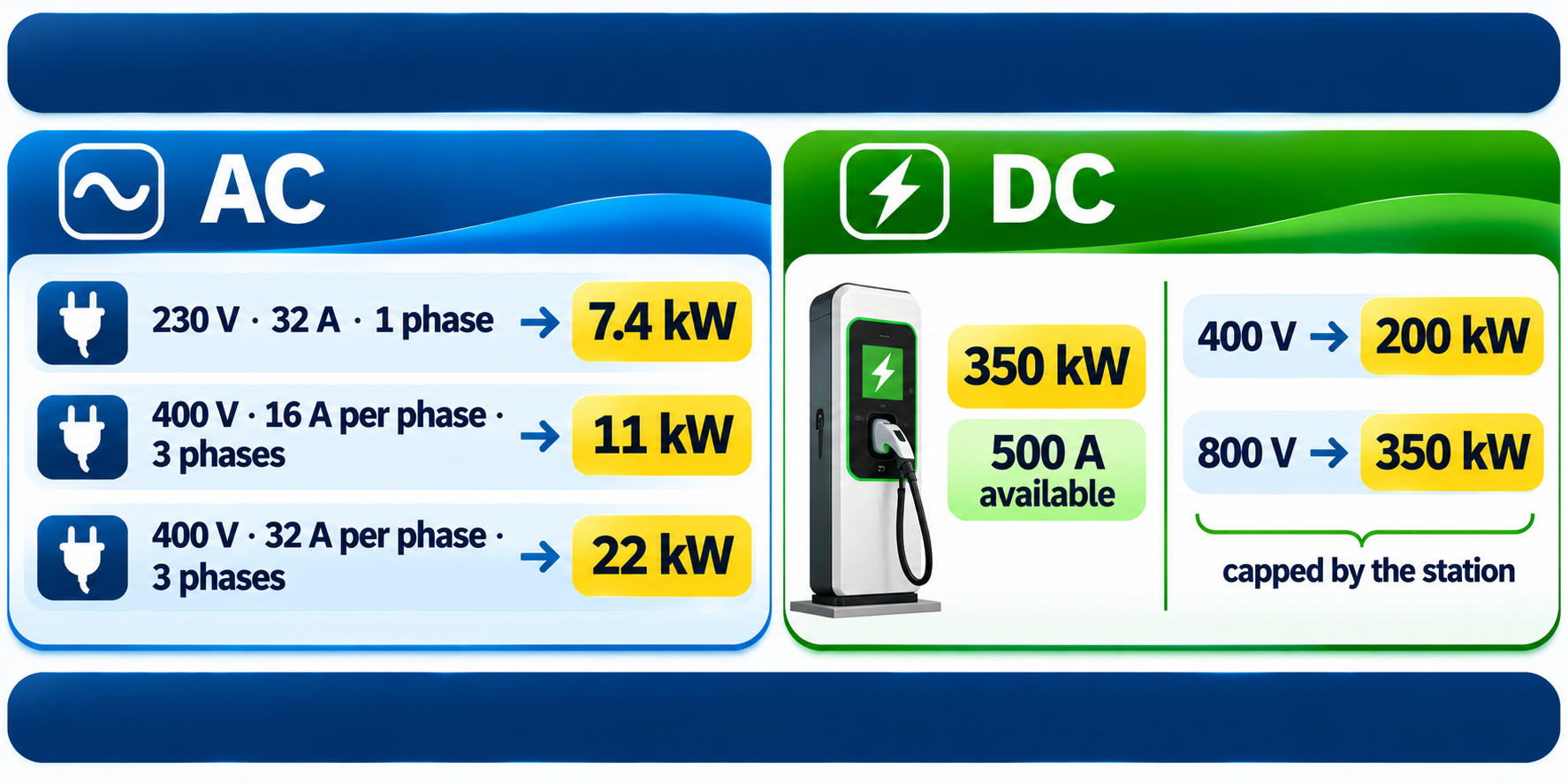
With AC, the onboard charger converts power for the battery. The car, cable and charge point must all support the relevant current and phase configuration. Site load management can reduce available current during a session. At nominal voltage, the figures below approximate AC input power before conversion losses. IEC 62196-2 · US Department of Energy AFDC · Onboard charger technical review
| Electrical supply | Approximate AC input | What it means for the cable |
|---|---|---|
| 230 V single phase × 32 A | 7.4 kW | A compatible 32 A single-phase lead can deliver the full current. |
| 400 V three phase × 16 A per phase | 11 kW | A 16 A three-phase lead can serve an 11 kW three-phase car. |
| 400 V three phase × 32 A per phase | 22 kW | The car, post and cable all need to support 32 A across three phases. |
| 240 V single phase × 40 A | 9.6 kW | North American example. Check the station’s attached lead and the car’s AC limit. |
A 22 kW post and 32 A three-phase cable give an 11 kW three-phase car about 11 kW. A single-phase car connected to an 11 kW post limited to 16 A per phase may draw only 3.7 kW. The post’s 11 kW rating is the sum across all three phases.
DC: check both voltage and current
On DC, the station supplies regulated power to the battery under vehicle control. The available power at a given moment depends on pack voltage, the current limits of the vehicle, station, cable and any adapter, and any lower cabinet or site limit. The car can request less as its battery warms, cools or fills.
| DC example | Approximate ceiling before vehicle limits |
|---|---|
| 350 kW unit, 500 A available, battery at 400 V | 200 kW |
| Same unit and current ceiling, battery at 800 V | 350 kW, capped by the unit |
These are calculated ceilings, assuming both voltages are supported and 500 A is available. They are independent of any particular vehicle’s charging curve. IONITY advertises CCS2 equipment up to 350 kW. Electrify America lists up to 350 kW for CCS and up to 50 kW for its CHAdeMO connectors. Nissan’s European LEAF manual lists up to 50 kW for the 40 kWh version and up to 100 kW for the 60 kWh version, so the same car can face a lower limit at a 50 kW site. ABB Terra HP manual · IONITY · Electrify America · Nissan LEAF manual
Buy the cable for the stop you actually use
For a socketed AC post, match the two ends, the current rating and the number of phases. Check where the inlet sits when parked, including when the adjacent bay is occupied. A longer cable can be useful if you often reverse into a bay with a front-mounted inlet, but adds bulk. Inspect the cable and plugs for damage before use and follow the equipment maker’s instructions. A domestic-outlet charging lead contains a control and protection unit and should be used only with a supply and equipment approved for that use.
A UK price benchmark is £149 including VAT for a 5 m Sync Energy Type 2–to–Type 2 cable rated 32 A, three phase, sold by Electricpoint. For a tethered home or public AC unit, the attached lead handles that stop. Budget for a portable cable if you also rely on socketed posts. Electricpoint listing
An adapter has a direction and a charging mode
SAE J3400 uses the same connector shape for AC and DC. Ford’s NACS fast-charging adapter, for example, connects a supported CCS1 vehicle to a compatible J3400 DC station. It is rated up to 500 A and 1,000 V, and Ford limits it to DC. Tesla’s app also distinguishes sites by vehicle eligibility, including locations with a station-supplied Magic Dock adapter. Check the manufacturer and operator for the exact combination. SAE J3400 · Ford adapter specifications · Tesla Supercharger access
Imported EV checklist before you pay
- Identify the actual car. Get the VIN, original delivery market, model year and a clear photo of every charging inlet. Read the manual for that market and variant. Ask whether the inlet or software has been modified.
- Prove local AC charging. Check voltage, frequency, phase count and current against the vehicle and equipment labels. Ask for a session on the kind of post you will use every week. Owners of older UK LEAFs have asked about this exact distinction when moving from home to public charging. Use the car and post documentation to verify the cable. Owner discussion
- Prove local DC charging separately. For CCS1, CHAdeMO, J3400 or GB/T imports, confirm station, communications protocol and any approved adapter with the manufacturer and operator. Require a test that starts and transfers energy. Inspect the session record and locate a second compatible site.
- Check support in writing. Confirm warranty and local service for the specific VIN, any approved adapter or conversion, and whether the local operator’s app accepts the vehicle and payment method.
If local AC works but local DC remains unverified, base the purchase decision on the charging access you can demonstrate. For a car that must cover long trips, confirm a compatible primary stop and a reachable backup before buying.