Electric Car Incentives: How to Check Grants, Rebates and Tax Credits Before You Buy
Check EV grant eligibility before you order. Compare 2026 rebates, registration relief and charger grants, and see when each benefit applies.
Table of Contents
An EV incentive can change the price you pay, the cash you need at delivery, or a tax bill later on. Before paying a deposit, ask the seller to identify the scheme, the exact vehicle variant, the date that determines eligibility and who submits the application. A headline rebate is useful only when you can trace it to your own contract.

The pre-order checklist
- Start with your registration address. Check the national scheme, then the state, province or municipality. Confirm which address the administrator uses, particularly if you are moving or buying across a border.
- Check the buyer. Verify residency, income or tax requirements, personal versus business use and any limits on repeat claims. Ask whose name must appear on the invoice, lease and registration.
- Identify the exact car. Record the model year, trim, drivetrain, battery, VIN if assigned, and whether it is new, a demonstrator or used. Check origin rules and how the programme defines the price cap. A manufacturer’s list price, the programme’s transaction value and your drive-away total can be different figures.
- Compare purchase and lease. Confirm minimum term, any prorating, and whether the lessor passes a benefit through. Ask for the upfront payment, total rentals, end-of-contract charges and any ownership option.
- Find the date that controls the claim. Record the order, pre-approval, invoice, delivery and registration dates separately. Check funding, application deadlines and what happens if the vehicle arrives late.
- Get the offer in writing. Ask for the pre-incentive price, each grant or discount, tax basis, who files, any approval reference and the balance due if a claim fails. Keep the signed contract and supporting documents.
Verified EV incentives by market
Snapshot checked 12 November 2026. Amounts are in local currency and depend on the buyer, vehicle and transaction. Each row links to the programme administrator.
| Market and scheme | Published amount or status | How you receive it | What to check before signing |
|---|---|---|---|
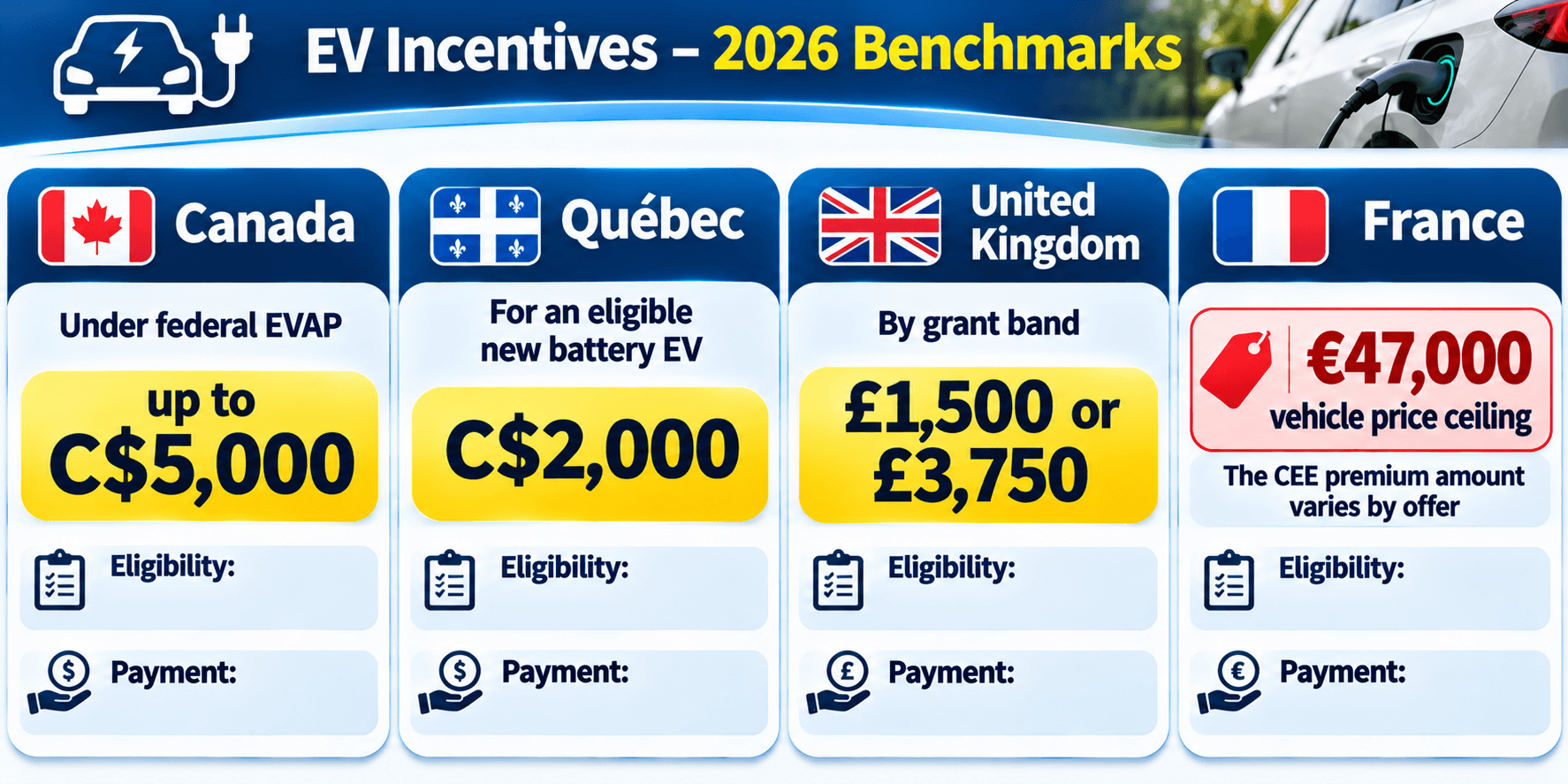
| Canada, federal EVAP | Up to C$5,000 for a battery EV and C$2,500 for a plug-in hybrid at 2026 levels. In 2027, up to C$4,000 and C$2,000. | Licensed dealer applies it after taxes and fees. | The dealer’s assessment submission determines the rate. Minimum lease is 12 months, with the full amount at 48 months or longer. |
| Québec, Roulez vert | C$2,000 for an eligible new battery EV in 2026. Eligible new plug-in hybrids receive C$500 or C$1,000. | Dealer can apply it or buyer can claim after the transaction. | Registration in your name determines the applicable rules. Check the provincial list and lease terms. |
| UK, Electric Car Grant | £1,500 or £3,750 on approved new cars. The programme’s price ceiling is £37,000. | Seller deducts the grant from the purchase price. | Match the exact derivative and band to the current official list and ask the dealer to confirm the order in the grant portal. Price-cap guidance |
| France, CEE Coup de pouce | Amount varies by provider and eligibility. The vehicle price ceiling is €47,000 including tax. | Deducted on invoice or paid later, depending on the offer. | Check the environmental score, the exact variant and the written offer from a participating provider. |
| Singapore, EEAI and VES | 2026 EEAI rebate is 45% of the Additional Registration Fee, capped at S$7,500. VES Band A is S$22,500. | Reflected in the registration calculation. | Check the registration date, fee calculation and emissions band. EEAI ends from 1 January 2027. |
| US, federal clean vehicle credits | Federal new and used clean vehicle credits are unavailable for acquisitions after 30 September 2025. | Earlier qualifying acquisitions follow IRS rules. State and utility schemes have separate terms. | A later delivery can qualify only if the earlier acquisition meets the IRS test. |
The IEA estimates that global public support for electric car sales reached about US$60 billion in 2025, even as average support per vehicle had fallen over the previous decade. The market-by-market rules above determine what an individual buyer can claim. IEA Global EV Outlook 2026
Canada’s federal C$50,000 test uses the programme’s final transaction value for eligible vehicles made in free-trade partner countries. Canadian-made eligible EVs have no cap under that rule. A listed vehicle can lose eligibility if the qualifying transaction value rises above the cap, while an otherwise eligible vehicle above it at list price can qualify after a discount. Ask the dealer to show which options, fees and discounts went into the calculation. Canada.ca incentive overview · Transport Canada examples
One delivery, two different clocks
Consider a qualifying battery EV delivered and registered in Québec on 28 December 2026. If the dealer submits an eligible federal assessment in December and closes the deal within its 90-day validity, the federal C$5,000 plus the provincial C$2,000 can reduce the bill by C$7,000. If the federal assessment is first submitted in January, the federal maximum drops to C$4,000. With the same qualifying December registration and C$2,000 provincial rebate, the combined example falls to C$6,000. Confirm both approvals and the applicable tax base. Québec calculates tax on the price before its rebate. Transport Canada timing and stacking · Québec registration and tax rules
On a lease, compare the total contract cost before and after assistance. A CIRANO working paper using historical US transactions found that how much of an incentive reached customers varied with its design and the type of transaction. Ask for identical lease terms on both quotes and compare the actual reduction across all payments. CIRANO working paper
Price the charger and ownership taxes separately
| Item | Benchmark | When to act |
|---|---|---|
| UK home chargepoint grant for renters and flat owners | 75%, up to £500, with qualifying private off-street parking | Apply and wait for eligibility notification before installation. Current OZEV schemes run to 31 March 2027 under published guidance. |
| Québec home charging station | C$600 for an eligible project | Keep equipment and installation invoices. Apply once you have the vehicle and the required registration details. |
| UK Vehicle Excise Duty | For qualifying electric cars registered from 1 April 2025, the 2026–27 rates are £10 in the first year and £200 at the standard rate | Check first registration and any expensive-car supplement separately from the purchase grant. |
| US federal charger tax credit, section 30C | The placed-in-service deadline was 30 June 2026 | Verify current state or utility options separately if you are planning an installation now. |
Put the amount due at delivery, any later reimbursement and any annual tax effect on separate lines. Keep the vehicle and charger quotes separate as well. If a rebate arrives after purchase, compare offers using both the eventual net cost and the amount you need to finance on delivery day.